
What is CST?
The CQC reports that dementia care requires person-centred support, specialised workforce training, and proactiveenvironments that shift away from reactive crisis management.
The CQC reports that dementia care requires person-centred support, specialised workforce training, and proactiveenvironments that shift away from reactive crisis management.
The CQC reports that dementia care requires person-centred support, specialised workforce training, and proactiveenvironments that shift away from reactive crisis management.
Cognitive Stimulation Therapy, or CST, supports all three. It's person-centred by design, it gives staff a clear, structured way of working, and it offers regular, planned engagement instead of reactive care. Ayla helps care teams deliver CST consistently and track the outcomes as they go.
What does CST involve in practice?
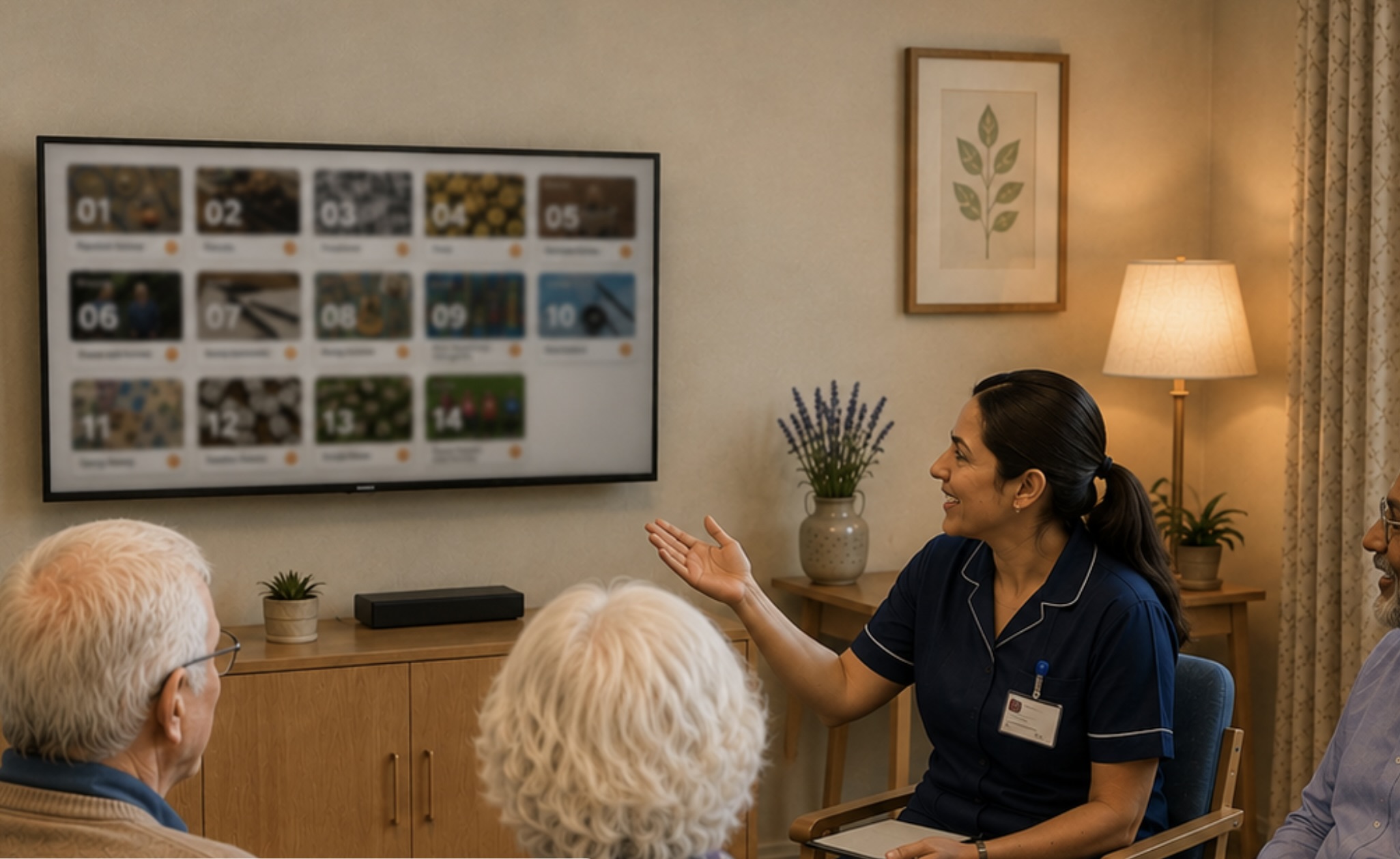
Typically, a CST programme runs for seven weeks (14 sessions, twice weekly, each about 45 minutes) for small groups of five to eight people with mild to moderate dementia. Sessions are themed, for example they might focus on music, childhood or current affairs. The goal is to activate cognitive functions in a way that is enjoyable, social and accessible to people living with dementia.
The manual for CST emphasises a combination of cognitive challenge, stimulation and social interaction. These three pillars have real impact, with one facilitator reporting,
I noticed people becoming more fluent and you could see people trying to express themselves more.
Another family carer said,
There is no argument that my wife's brighter.
Why do experts recommend CST?
Perhaps the most compelling reasons is the strength of the evidence behind CST.
University College London (UCL) state:
Cognitive Stimulation Therapy (CST) is an evidence-based group intervention shown to improve quality of life and cognition in people with dementia,
Economic analysis also shows CST is cost-effective, and according to UCL, the improvements in cognition compare favourably with trials of cholinesterase inhibitors for Alzheimer’s disease. In the UK, the National Institute for Health and Care Excellence (NICE) recommends that people with mild/moderate dementia of all types, should participate in group CST, and that this should be,
commissioned and provided by a range of health and social care workers with training and supervision.
In other words, if you run a care home that serves people living with dementia, CST is not just an optional extra - it is increasingly seen as a standard of good practice, especially in early/mild-to-moderate phases, and certainly one that regulators and commissioners may soon expect to see.
What results are seen in practice?
Beyond the original trials, more recent real-world deployments show promising outcomes.
At Surrey Heights Care Home, part of CHD Living, 75%of residents showed improvement in positive outlook on life and 75% maintaining or improving their ability to adapt after completing a programme of CST with Ayla.
At Emerson Grange, part of Cinnamon Care, every cognition domain moved in a positive direction for the whole group. Indeed, 100% of the residents recommended the programme, with one resident saying,
I like that we are together and chatting.
What this means in real terms is that your residents may have improvements in cognition, language/communication, mood,social engagement and overall wellbeing - not just tiny changes, but meaningfulones. For a care home operator, that can translate into better resident experience, positive family feedback, stronger reputation and potentially improved occupancy and retention.
Why should a care home operator introduce CST?
From an operational perspective, there are several strong arguments for introducing CST.
- Firstly, offering CST to your care home through the Ayla platform signals your home is not just a residential setting, but one that offers an evidence-based therapeutic intervention for people with dementia. This is a differentiator in a competitive market, and shows how proactive you are in your support for residents with dementia.
- Secondly, the improvements in resident cognition, engagement and mood can contribute to better outcomes overall. It could mean fewer distressed behaviours, better social interaction, improved quality of life, which in turn support staff morale, resident satisfaction and the environment of care. The programme also offers a wonderful opportunity to upskill your care teams. Due to the measurements, the Ayla platform encourages reflective practice, enabling the facilitators to get to know their residents in a deeper way.
- Thirdly, regulatory or commissioning bodies are increasingly looking for robust dementia-care pathways, including non-drug therapies. As reported earlier, the CQC has strict guidelines for dementia care, which CST support across the board.
What about the NHS and commissioning?
In the UK, the NHS memory services and other dementia care pathways include non-pharmacological interventions such as CST, but this varies depending on your local services.
CST is offered by some NHS trusts in the UK, and people who have been diagnosed with dementia by a memory service can ask if CST is available locally. For care homes this suggests you may deliver CST in-house (or in partnership) and therefore position your home as a provider of a higher-standard therapy service.
How does Ayla support?
Ayla helps care teams bring evidence-based Cognitive Stimulation Therapy into everyday care, simply and consistently through its easy-to-use platform. Our expert team train and support your staff so they confidently follow the programme and accurately measure outcomes.
Book a demo